Founder Notes
Why I'm Protecting LoveHuddle's Biggest Ideas — and Why I'm Taking My Time
14 Oct 2026 · At 61, I'm building a technology company from South Wales. I don't have millions in funding or a large development team. I've made sacrifices, questioned myself and spent countless nights learning things I never imagined I'd need to know. But I believe this idea deserves a chance.
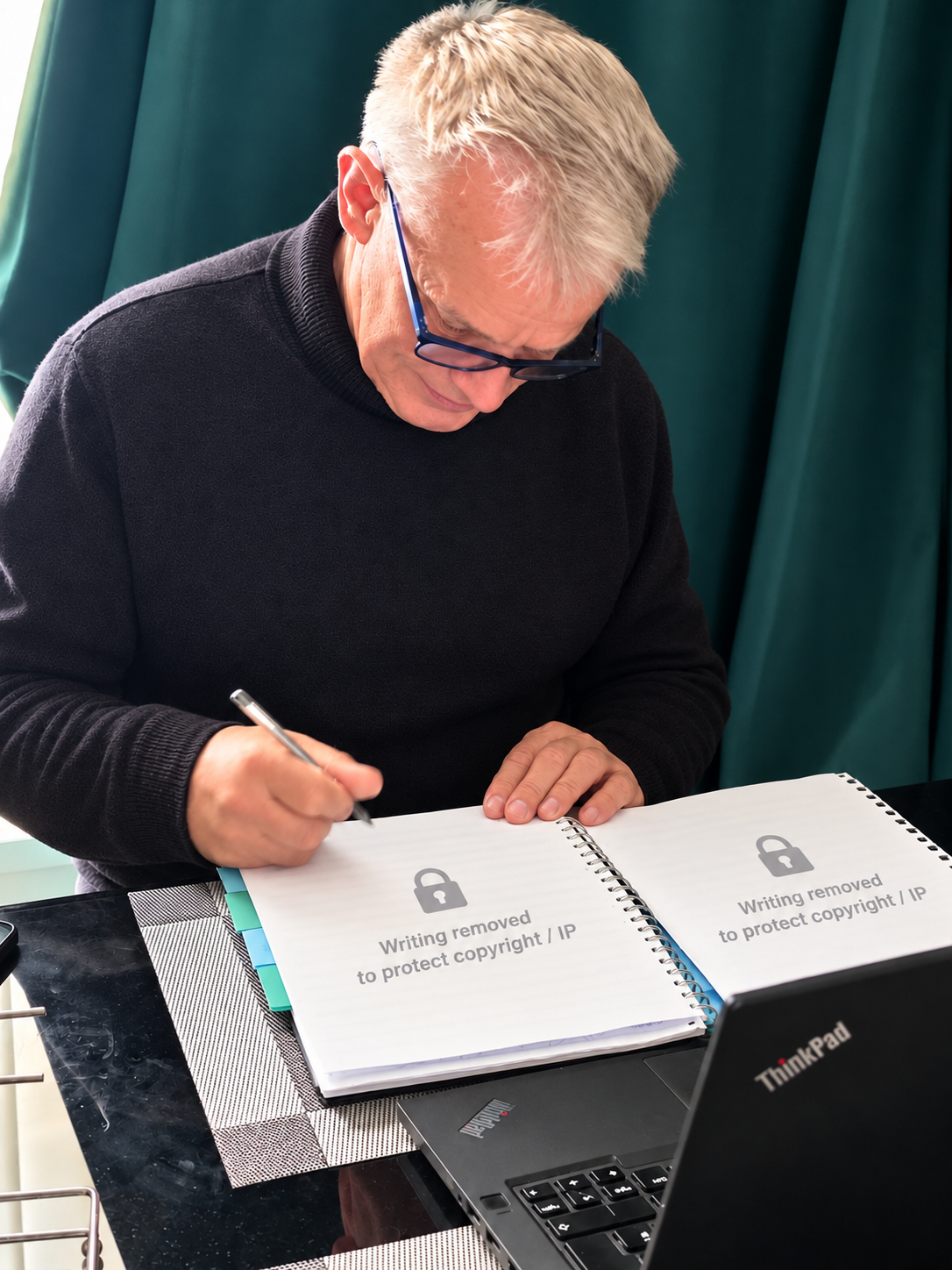
I Didn't Set Out to Build Just Another Dating App
I'm 61 years old, I live in South Wales, and I'm building something I genuinely believe could offer people a different way to meet online.
I'm also a part-time coach driver.
I don't come from a technology background. I don't have millions in investment, a large team of developers or an office full of people working on my ideas.
What I do have is a vision I've spent years developing, a small team helping bring it to life, and a determination to see how far we can take it.
I've also made a decision that might frustrate some people: I'm not revealing everything about how LoveHuddle works before we launch.
Not because there's nothing to show, but because there's something worth protecting.
There are thousands of dating apps. Tinder, Bumble, Match and others have helped millions of people find each other, and I respect what they've achieved.
But I also believe there are people who want something different. People tired of endless swiping, ghosting, fake profiles and conversations that go nowhere.
I don't think online dating is broken. Swiping works for plenty of people. But surely there's room for another approach?
I wanted to create something enjoyable, natural and focused on genuine human connection. Something different by design.
Where the Idea Came From
I spent around a year researching how people connect online. I looked at dating platforms, Facebook, Instagram and the different ways people interact socially.
I also looked back at what happened during the COVID lockdowns, when millions of people were looking for ways to connect without physically meeting.
One particular idea from that period caught my attention. It became incredibly popular before eventually fading away. That surprised me. It made me think about what people actually enjoy when they interact online.
I'm keeping the details of that particular inspiration private for now because it forms part of the thinking behind LoveHuddle.
But there was also a more personal reason.
A friend of mine, who had experienced dating scams on more than one occasion, spoke to me about how difficult it could be to find a genuine connection online. That conversation stayed with me.
It made me think about vulnerability, trust and the responsibility platforms have towards the people using them.
Combined with everything I'd been researching, it led me to ask a question: what if I could bring different ways of connecting together into something genuinely different?
Not another dating app with a new colour scheme. A different experience altogether.
From an Idea to an Entire Product
Then came the problem. Money.
My original concept required considerable bandwidth, technology and development resources. I simply couldn't afford to build everything I imagined.
And getting investment is far more difficult than some of the success stories you read on LinkedIn might suggest.
You hear about startups raising millions, but you don't hear nearly as much about the founders spending months looking for investment, getting nowhere and continuing to fund their businesses themselves.
So I scaled the original idea back. But something interesting happened.
The more I researched and developed the concept, the more possibilities I began to see. One idea led to another.
What started as something relatively modest gradually became a much more ambitious project.
Today, we have two detailed development blueprints, each around 25 pages, and we're developing our own technology, AI-Huddle-Core, designed around safety, trust and a people-first approach.
I never imagined when I started that the idea would grow to this scale. And I certainly never imagined how much I would have to learn along the way.
The Part Nobody Sees
There's a version of this story where a founder has a vision, finds a team and everything falls neatly into place. That isn't mine.
When my developer told me he needed the complete user flow before he could start building, I had never designed a technology product in my life. I didn't know what I didn't know.
Suddenly, I had to understand every stage of the experience. How would people enter LoveHuddle? Where would they go? What would happen when they connected? How would the safety systems work? What happened if something went wrong?
Every answer seemed to create another question.
My developer pushed me hard on the flow, the design and the smallest details. And I had to learn quickly. Often late at night. Sometimes after a full day at work.
There were sleepless nights, frustrations and moments when I genuinely wondered whether I'd taken on too much. In the early days, there were times when I felt like giving up.
And yes, my developer and I have had some passionate arguments. Not because we don't respect each other, but because we both care about getting this right.
Sometimes I wanted something designed a particular way, and he would explain why it wasn't technically straightforward. Other times, he'd challenge my thinking, and I'd have to go away, research it and come back with a solution.
One day, things became so intense that he told me: “Kevin, take the day off. Take your wife out. Don't do anything.”
So I did. Although I still couldn't switch off. Even on holiday, LoveHuddle has come with me.
My wife has also had to live with this journey. The late nights, the frustrations, the financial pressures and the times when my mind has been completely occupied by another development problem. I'm grateful for her patience and support.
The truth is, there hasn't been a single day since I started when I haven't either worked on LoveHuddle or thought about it.
Some days I'm sitting in a coach between jobs, working on my laptop. Other days I'm at home reviewing development plans, artwork, safety policies or trying to understand another piece of technology.
I've had to learn about artificial intelligence, product design, data protection, online safety, intellectual property and areas of business I knew very little about when I began. And I'm still learning.
At 61, voluntarily moving from full-time to part-time employment to give a startup more attention isn't the most comfortable financial decision.
There are bills to pay, household expenses to consider and the same cost-of-living pressures facing families across the country. I won't pretend the sacrifices haven't been difficult.
But I knew that if I wanted to give LoveHuddle a proper chance, I needed to make more time for it.
My developer is also balancing university studies with building the platform and developing our AI systems. Our artist is working hard to bring LoveHuddle's visual world to life.
We're not a company with hundreds of employees. We're a small team trying to turn an ambitious vision into something real.
And despite the challenges, there's something incredibly rewarding about watching an idea that once existed only in your imagination gradually come to life.
Why I'm Protecting Our Intellectual Property
Imagine you've spent years developing an original computer game. You've researched it, designed it, funded it yourself and worked with a small team to bring it to life.
Would you publish every detail of how it works before you've even launched? Probably not.
A much larger company, with twenty developers and a substantial budget, could potentially develop something similar far more quickly.
That's how I feel about LoveHuddle. I'm not accusing anyone of wanting to copy us. I'm simply being commercially careful.
We've invested considerable time, effort and money in developing our ideas.
I'm not claiming that every individual feature has never existed before. What I believe makes LoveHuddle different is how everything comes together as one experience.
That's what I want people to discover when they finally use it.
Of course, having an idea and successfully delivering it are two very different things. We still have to prove that what we've designed works in practice.
But I want LoveHuddle to have a fair opportunity to establish itself.
I'm not protecting our ideas because I'm afraid of competition. I'm protecting them because I believe they're worth competing for.
Collaboration, Not Competition
Let me be clear about something. I'm not building LoveHuddle to attack Tinder, Bumble, Match or anyone else.
I respect what those businesses have achieved. They have experience, resources and expertise that a small startup like ours can only dream of.
My ambition is to give people another choice.
And protecting our intellectual property doesn't mean I'm closed to working with established businesses. Quite the opposite.
If an experienced company, investor or industry organisation believes there's something worthwhile in what we're creating, I'm open to a conversation. That could be during development or after launch.
Naturally, commercially sensitive discussions would need to happen on fair terms, with appropriate confidentiality protections.
But I'm not building LoveHuddle simply in the hope that a bigger company might eventually come along and buy it.
I'm building it because I believe in the concept. And I'm prepared to continue independently.
Encouragement From the Industry
One of the most rewarding parts of this journey has been discovering that other people believe LoveHuddle is worth pursuing.
We've received recognition through the UK StartUp Awards, the Great British Entrepreneur Awards and a Global Recognition Award.
For someone who isn't from a technology background, that recognition means a great deal. But awards don't guarantee success. They're encouragement, not proof that a business will work.
I'm also proud of LoveHuddle's involvement with the Online Dating and Discovery Association (ODDA), led by its Chief Executive, Simon Newman.
Our discussions have focused on safety, trust and responsible development, with the aim of working towards recognised industry standards and best practices.
Simon has reviewed confidential aspects of LoveHuddle's development blueprints under a non-disclosure agreement, and I've valued his experience and willingness to understand what we're trying to achieve.
Attending the ODDA event in London in October was another important opportunity to learn from experienced people across the online dating industry.
I travelled from South Wales because I believe that if you're serious about entering an industry, you need to listen to the people who understand it.
For a small independent company without a large compliance department or team of industry specialists, those opportunities are particularly valuable.
No dating platform can promise complete safety. I would never make that claim.
But I believe we have a responsibility to take every reasonable step to protect people, understand the risks and build safety into the experience from the beginning.
That commitment has influenced some difficult decisions. Including one about our launch.
Why I've Decided to Delay the Launch
I'll be honest. I'm nervous.
Not because I've stopped believing in LoveHuddle, but because I understand how much responsibility comes with putting a new platform in front of the public.
There will be bugs, technical challenges, unexpected problems and things that need improving. That's the reality of software development.
And the LoveHuddle we're building today is considerably bigger than the one I first imagined.
More development means more artwork, more testing, more technical work and inevitably more cost.
We've already invested so much time and effort in getting this far. I don't want to undermine that work by rushing the final stages.
So I've made the decision to move our planned launch to early 2027.
That gives us additional time for development, testing, safety work and learning from experienced people within the industry.
I know some people will be disappointed. I'm disappointed too.
Nobody wants to see their own project delayed, especially when they've been working on it for so long.
But there's something more important than meeting an announced date. Getting the fundamentals right.
I don't expect perfection. No technology platform can promise that.
But when you're building something around trust, safety and genuine human connection, you have to take those responsibilities seriously.
I'd rather explain a delay now than launch something prematurely and wish I'd waited.
Some things are worth taking a little longer to get right. I hope LoveHuddle will be one of them.
What If LoveHuddle Doesn't Succeed?
Every founder has to accept something. You can believe in an idea with all your heart and still not succeed.
Open a corner shop tomorrow and you might do brilliantly. Or you might struggle. You might even have to close.
Nobody can guarantee success, no matter how much research they've done or how strongly they believe in their business.
But does that mean you shouldn't try? Of course not.
You research your market, understand your costs, listen to people, learn from mistakes and give yourself the best possible chance. That's what I'm trying to do.
I've spent considerable time researching the dating industry and talking to people both inside and outside it. The response has been overwhelmingly encouraging.
But encouragement isn't the same as actual users. The real test will come when LoveHuddle launches.
Some people will love it. Others won't.
Marketing will be one of our biggest challenges, and I know that building a platform is only part of the battle. You still have to persuade people to try it.
I don't know whether LoveHuddle will become a major success.
I don't know whether we'll eventually attract substantial investment, develop meaningful partnerships or remain a small independent company.
What I do know is that without belief, research, perseverance and a willingness to take sensible risks, many businesses would never get started.
And I'd rather try than spend the rest of my life wondering what might have happened.
A Founder From South Wales With a Big Idea
Sometimes I look at the enormous technology companies in Silicon Valley. The investors. The engineers. The resources.
And I ask myself a question. Can someone like me really compete?
A coach driver from South Wales, approaching 62, building a technology company without the financial advantages enjoyed by much larger businesses.
I don't know the answer.
But I don't believe the size of your bank account, your age or your background should determine whether your idea deserves a chance.
I've made sacrifices. I've made mistakes. I've had sleepless nights, difficult conversations and moments when I've questioned whether I can really pull this off.
But I've also learned more than I ever imagined.
I've met people across an industry I once knew very little about. And I've watched something that began as an idea gradually become a real product.
I keep coming back to one question: what if this actually works?
What if people enjoy meeting in a different way? What if we can create an experience that makes genuine connection feel more natural?
What if a small independent company from South Wales can contribute something worthwhile to an industry dominated by giants?
I know there will be criticism. I know we'll make mistakes. And I'm not expecting everyone to agree with my vision.
I'm simply asking for a fair chance.
When LoveHuddle launches, I want people to judge it by the experience we've created. Not by promises. Not by publicity. By what we've actually built.
Until then, I'll continue sharing the journey, learning from the people around me and protecting the ideas we've worked so hard to develop.
Because at 61, I've learned something important.
You don't have to be young, wealthy or come from a technology background to have an idea worth pursuing.
Sometimes you just have to believe in something enough to give it a chance. And that's exactly what I'm doing.
Kevin Peddie
Founder, LoveHuddle Ltd
South Wales, United Kingdom
LoveHuddle — A different way to meet, connect and discover people.
www.lovehuddle.com